The UN negotiators reached a deal in Cancun very early this morning. It's being praised from virtually all angles, and it's being labeled as "modest" at the same time.
continued at Daily Kos....
The UN negotiators reached a deal in Cancun very early this morning. It's being praised from virtually all angles, and it's being labeled as "modest" at the same time.


OK, so my previous post might have been a teeny bit alarmist. But, hey. We need a good slap in the face right now.
The good news is that those bleak scenarios need not become reality. The future has not yet been written. We are at what many call the jumping off point. We can stand on the edge of the diving board for hours, wetting ourselves, skeerd about diving in. We can succumb to cowardice & crawl backwards and give up.
OR, we can jump forward boldly and proudly. Who cares if we dive gracefully, cannonball, or belly flop? We will be in the pool where we wanted to be in the first place.
And, yes, if we don't jump in the pool, and quickly, the water will indeed rise and engulf us eventually anyway.
Hope for mankind is there to be found. Below are a few examples for those feeling exasperated and doomed. If we ramp up our efforts, the sky is the limit. Heck, we might even leave a world for our kids about which we can be proud!
This diary is about the Cancun summit, saving the rainforests, the climate crisis, and Jane Goodall. I love Jane Goodall, but right now, she's full of shit. If you're one of the world's leading conservationists and you find yourself agreeing with the head of Wal-mart and the head of the World Bank on something, you need to ask yourself why whatever you're for is probably something you oughta be against. And that's where Jane Goodall finds herself right now.
Now, she's not the only one to point a finger at. There are an awful lot of total sleezebags who are all for the same thing. She's the one in the group who shouldn't be there. She's the one who oughta know better.
I'm a newbie when it comes to learning about saving the rainforests and the rights of indigenous people's in the Global South. I've only just visited the Amazon for the very first time, this year. But it doesn't take a lot of time there to learn to recognize bullshit when you see it.
फ़ेस् फ़ीयर् विथौत् फ़ीयर्
"Fear the threat until it comes. When it comes, turn and face it without fear." Sanskrit.
In no uncertain terms, officials and scientists representing Bangladesh at the Cancun talks made it clear yesterday that their country, which unabashedly occupies Ground Zero in the climate wars, is fearless and righteously proud in its determination to save itself by ensuring it receives an equitable share of fast track financing to assist developing countries in adapting to climate change.
"Loans are not an option for my country," said Bangladesh Minister of State for the Environment Dr. Hasan Mahmud. "We did nothing to create this problem and we should not be charged in solving it."
Unless something is done now, chances are in less than 40 years you will look at the map and Bangladesh will no longer be there. What will remain of this country will not be recognizable.
I don't know about you, but following all the different angles of negotiation at a conference as broad and multidimensional as the UNFCCC makes my head spin. I understand that dealing with a complex problem like climate change that literally affects every nation and every individual on earth offers no simple solutions, but the pitfall of trying to think about everything can be that you end up doing nothing.
This is why I'm very pleased to see that local governments and their representatives are gaining some real traction in Cancun.
On Saturday, local governments took a huge step when the Subsidiary Body for Implementation (SBI) officially adopted the concept of "governmental stakeholders" for the first time in UNFCCC history.
In a completely unscientific study, Green Media News has found the biggest obstacles to reaching a global deal on climate change are the massive overwhelm and emotional disconnect that stop climate change issues from becoming part of the national discourse.
Huh?
OK, I'm overwhelmed with all this. And I have a high tolerance for minutia; if I'm overwhelmed, that's not a good sign for the climate movement.
I have to admit I'm torn. I've been reading news from Cancun all afternoon. And I'm tempted to go down the list and talk about all the things that are happening at COP16 and around the world relative to climate change.
Fyi this article was cross-posted to Green Media News at around midnight last night.
In a stunning series of short films depicting last summer's biblical floods, Pakistan today issued a passionate and powerful appeal to the heart and soul of the international community.
Calling for COP16 negotiators to rise about politics and circumnavigate the complexities which have a stranglehold on both process and progress, a panel of Pakitani ministers, ambassadors and scientists called on the parties to reach agreement on an adaptation fund which recognizes and adequately addresses the disproportionate impact of climate change on the world's most vulnerable populations.
"Pakistan is on the front line in two wars, the war against terrorism and the war against climate change," said Khalid Sherdit, Director General of PDMA and General Relief, Punjab. "Both battles need global coordination and cooperation, Both are unpredictable. But in the war against climate change, there is no exit plan."

Welcome to the eKos Earthship, your one-stop-shop for green diaries and series.
Today's editor: LaughingPlanet
••
••
(Reuters) - China on Monday offered for the first time to submit its voluntary carbon emissions target to a binding U.N. resolution, buoying climate talks where Bolivia accused rich world policies of causing "genocide."
••
••
Beneath the fold you will find news and notes, community announcements, and our eco-diary roundup.
All views expressed by today's editor do not necessarily represent those of eKos or eKos listed diarists.
India’s Minister of State for Environment and Forests Shri Jairam Ramesh chaired a impassioned Saturday panel on "Equitable access to Carbon Space: A Paradigm for Agreement," promoting a 'shared vision' for negotiations based upon equitable 'carbon space' for developing countries
An enthusiastic crowd spilled out into the corridors to continue discussion after the expert panelists indicated keen interest in a few of the inspired ideas floated during the Q&A, all seemingly 'pie-in-the-sky' suggestions -- like advancing a shift from gold to a global carbon standard or replacing traditional finances with effort based systems as bargaining chips.
Later that evening, expectations ran high at the World Climate Summit, hosted by Carbon War Room co-founder and eco-gladiator Sir Richard Branson, who presented the first ever Gigaton Consumer Discretion Award to one of the Global 1000 climate conscious companies.
Raising a buzz poolside today that if big news does breaks from Cancun, it just might come from a highly unexpected source.
We're staying at the youth hostel in downtown Cancun, away from the strip of beach hotels that draw $3 billion in tourist trade each year. But I went down there this morning for a meeting, and found myself in a little outpost of the United States: Starbucks, KFC. Chili's (Are you kidding me? Chili's in Mexico?)
And here's the thing--as usual, the conference center is an outpost of the U.S. too. From the very beginning of this process, 16 long Conferences of the Parties ago, it's U.S. politics that have set the tone and pace. And every time with the same message: be less ambitious, so Congress won't nix the deal. That's why we ended up with a Kyoto pact that was a babystep at best. That's why the treaty that was supposed to result from Copenhagen ended up an empty Obama-written 'pledge.' We're very, very mindful of the importance of our domestic legislation," his chief negotiator Todd Stern said at the time. "That's a core principle for me and everyone else working on this. You can't jeopardize that."
Welcome to the eKos Earthship, your one-stop-shop for green diaries and series.
Beneath the fold you will find news and notes, community announcements, and our eco-diary roundup.
Peruse the eKos Library to find previously listed diaries. You can also follow eKos on Twitter.
Tonight's editor: boatsie reporting live from Canunmesse
For many women living in the Cook Islands, collecting yellow land snails to make jewelry and other handicrafts is their sole source of income. Recent extensive dry spells have made these shells more difficult to find.
"Sometimes we will spend weeks on end to fill an empty can which we used to fill within a few hours," says Tangiruaine Ngaruaine. "At the beginning of this year, it was truly tough because there was hardly any rain. Whatever I make from selling these shells is my 'income' and it has been my only source of income."
Ngaruaine's story is represented here at COP16 by Ulamila Wragg, one of an expanding number of women participating in official UNFCCC climate negotiations.
Wragg is here at COP16 an an official delegate for the Cook Islands, one of the women delegates funded and trained by the Women's Development Fund to represent female voices, particularly those of women who are disproportionately impacted by the impacts of climate change in least developed countries.
Cross-posted to Green Media News.

Let's face it - Climate Change talk is boring. Most people just don't get excited talking about things like "MRV" (the monitoring, reporting, verifying and reducing of greenhouse gas emissions across geo-political borders) and those who aren't on the front lines of the climate change action movement generally don't have the attention span to focus on serious talk like this... well at least, not when "Dancing with the Stars" is on.
Delegates from island nations have come to the climate summit in Cancun to talk about sea level rise. Their concerns are understandable. Current projections for sea level rise range from 1 to 2 meters by end of the century if global temperatures rise 2 to 4 degrees C. A recent Oxford University study estimates these islands face devastatingly high annual costs to repair damage and maintain infrastructure from sea level increases of these magnitudes.
"All of us face disaster. We don't want to be the forgotten, the sacrificed countries of the 21st century."
Antonio Lima, UN ambassador for the Cape Verde Islands
You know that time before takeoff? When you hear about how these invisible oxygen masks are going to magically drop down to save you in case of an emergency? How if you’re traveling with a child or someone with limitations, you should put yours on first and then help those who can’t help themselves?
No matter how many times I hear this, I think twice. My gut instinct is to help those who can’t help themselves before thinking of myself.
Black Zanate birds flock in the colorful framboyan trees above Plaza de la Forma as the citizens of Cancun convene to welcome and bless COP16 with a celebration of prayers, songs and short impassioned speeches.
"We need an answer," says Rodolfo Urapilleta, one of the few volunteers on hand who speaks English. "Tonight we are getting together to pray. I don’t know how but maybe the Lord can do something."
This week in Cancun, governments and NGOs from around the world are taking another shot at solving the climate crisis after last year's highly anticipated VIP-laden COP 15 conference in Copenhagen that created a big bubbly buzz and ended in a long contemplative sigh of nothingness.
While much of the approach to the Big Kahuna in Cancuna is still centered around cryptic diplomat speak that tries to accommodate everybody and pleases nobody, the one question that the indefatigable ecocity advocate Richard Register has been asking for over 35 years — Why on earth aren't they talking about cities??? —
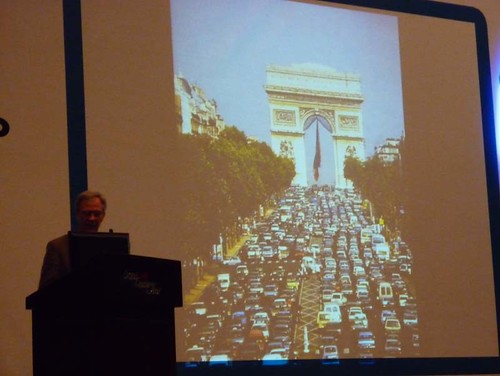
seems to finally have been heard:
After cities were shut out at COP15, Marcelo Ebrard, Mayor of Mexico City and Chair of the World Mayors Council on Climate Change, has been invited to speak at a high level panel at COP16.
Cross-posted to Green Media News.
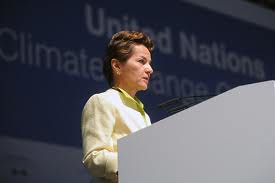
In her opening remarks at COP16 yesterday, United Nations Climate Chief Christiana Figueres called for a "solid response to climate change, using both reason and creativity."
Meanwhile, one delegate on the ground reported feeling a strange mix of hope and frustration in the air as the negotiations were about to begin.
Figueres concentrated her remarks on the three issues she sees as the most important reasons why a global climate action deal needs to be reached and why the UNFCCC is the right body to be driving the process:
Cross-posted to Green Media News.
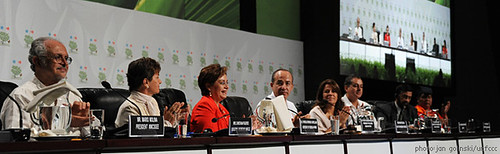
Representatives from countries around the world gathered today in Cancun, Mexico for the COP16 climate talks which will continue for the next 12 days. This is the first round of talks by the UNFCCC (United Nations Frameworks Conventions on Climate Change) since last year's COP15 conference in Copenhagen, Denmark.
COP15 last year failed to produce a world-wide agreement on reducing greenhouse gas emissions, which was expected by a large majority of the world's population. Therefore, expectations for COP16 this year are very low. Notably different this year is the stated intention of the non-governmental organizations (NGOs) to cooperate with politicians and negotiators rather than play an adversarial role.